Solid and Oil Fragrance Documents: The Compliance File a First Founder Builds
Compliance paperwork for a solid or oil fragrance is not a single pack you request at the end of the project; it accumulates at three moments, and each moment produces documents that later ones depend on. Because these formats are leave-on cosmetics, the allergen disclosure threshold is lower than for a rinse-off product, and because the base is formulated rather than bought as a liquid, the safety assessment has to cover the base as well as the fragrance. A first-time founder who collects the right papers before sampling, before the purchase order and before shipping avoids the expensive version of this lesson, which is discovering a missing document when a retailer or a customs broker asks for it.
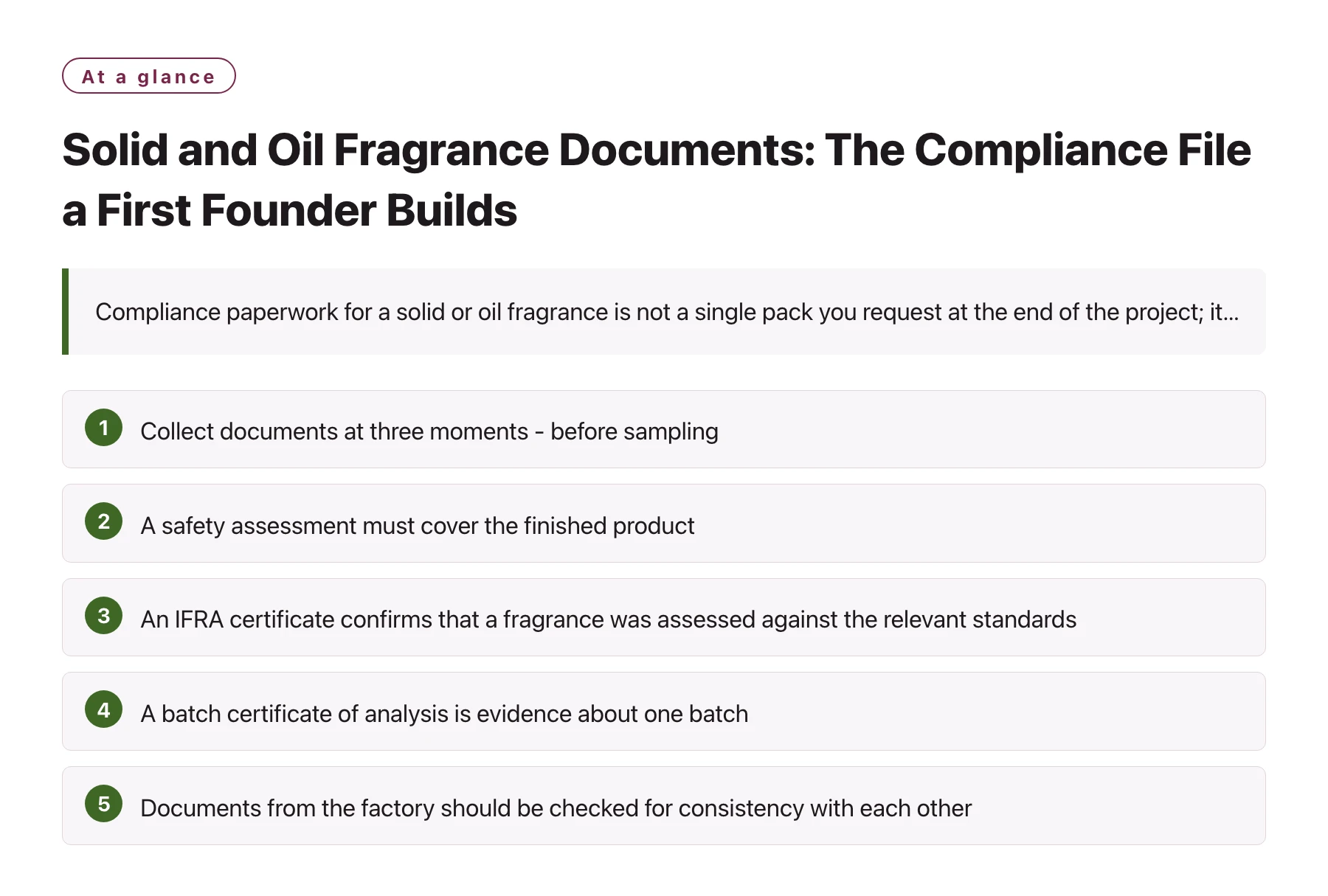
Key takeawaysCollect documents at three moments - before sampling, before the bulk order and before shipping - because replacing a missing paper later is slower than requesting it early. · A safety assessment must cover the finished product, base included, so ask who prepares the cosmetic product safety report and who acts as the responsible person if you sell into the EU. · An IFRA certificate confirms that a fragrance was assessed against the relevant standards, but it is tied to a product category and a use level, so it has to match your format. · A batch certificate of analysis is evidence about one batch, not about the system that produced it; the GMP certificate and the batch record are the system-level evidence. · Documents from the factory should be checked for consistency with each other, because the cheapest errors to catch are the ones where two papers name different products.
Founders usually meet compliance in the wrong order. They sample, they choose, they place an order, and only when a distributor or a marketplace asks a question do they start assembling paper. By then the people who could answer quickly have moved on to other projects.
Solid and oil formats add one complication to that sequence. The product is leave-on, so the labelling threshold for fragrance allergens is the lower one, and the base itself is a formulated cosmetic ingredient mix rather than an inert carrier. The safety file, therefore, has to describe the actual article you are selling.
This walkthrough sets out what to request and when, what each document proves, and the three gaps that turn up most often in first orders.
What changes when the product is not a spray
The regulatory category does not change because the product is solid or oil-based. In the European Union, fragrance is treated as part of a cosmetic product, and the rules on ingredients, labelling and safety assessment apply to it in the same way they apply to an eau de parfum [1]. What changes is the arithmetic behind those rules.
Fragrance allergens that must be declared on the label have separate thresholds for leave-on and rinse-off products, and leave-on products sit at the stricter number. A solid stick or a roll-on oil is leave-on, so a formula that carries a given allergen must disclose it at a lower concentration than a shower gel would. That is a labelling consequence of the format, not a flaw in the formula.
The second change is the base. In a spray, most of the mass is solvent and water. In a solid or oil, most of the mass is a wax, butter or carrier oil that stays on the skin, so the safety assessment has to consider those materials and their impurities, not only the fragrance compound.
None of this means a founder needs to become a regulatory specialist. It means the questions have to be asked early, and the most efficient way to ask them is to work with a perfume factory that already exports into the markets you are targeting, because those questions will have been asked before and the answers should arrive without escalation Xuelei perfume factory.
Why the safety report is the document founders underestimate
A cosmetic product safety report is prepared by a qualified safety assessor and, together with the product information file, supports the claim that the finished product is safe for its intended use. In the EU the product must also have a responsible person established in the market, and the product is notified before it is placed on the market.
For a solid or oil product, the assessor needs the full formula including the base, the allergen content, the packaging materials that contact the product, and the stability and compatibility data. If any of those four inputs is missing, the assessment either stalls or is written with assumptions that later turn into a change request.
Other markets add their own paper
Requirements differ by destination. Canada, for example, requires cosmetics to be notified and places obligations on the company that sells them, with its own rules on ingredient disclosure and labelling [2]. A factory that exports regularly will know which markets want a free sale certificate, a certificate of origin or a specific notification, and it will say so early if you tell it where the product is going.
The practical advice is to state the destination markets in the brief. Suppliers answer document questions far more usefully when they know whether the product is going to a European retailer, a North American marketplace or a Gulf distributor.
Three moments to collect the file
- Before samplingAsk for the safety data sheets for the base materials and for the fragrance concentrate, the material restriction assessment for your product category, and a written statement of which steps the factory performs on site. These papers let you check early whether the base and the fragrance can legally sit together at the load you want.
- Before the purchase orderConfirm in writing who prepares the safety assessment, who holds the responsible person role in each destination market, and who owns the product information file. Also fix the label artwork content now, because the ingredient list, allergen declaration and net content all depend on the final formula and fill weight.
- Before shippingCollect the batch certificate of analysis, the manufacturing record summary, the retained sample reference, and the transport documents including the safety data sheet version that matches what was actually shipped. Check that every document names the same product, the same batch number and the same fill weight.
Documents, issuers and what each one really proves
| Document | Who issues it | What it proves, and what it does not |
|---|---|---|
| Safety data sheet for base and concentrate | Material supplier or factory | Hazard and handling information for the material as supplied. It is not a statement that the finished product is compliant or safe on skin. |
| IFRA conformity statement | Fragrance house or evaluating laboratory | That the fragrance was assessed against the standards for a named product category and use level. It says nothing about the rest of the formula and expires when the standard is revised [3]. |
| Allergen declaration | Fragrance house or factory | Which declarable allergens are present and at what concentration in the finished product. Whether each one needs a label mention depends on the leave-on threshold. |
| Cosmetic GMP certificate | Certification body | That the site was audited against a recognised good manufacturing practice standard at a point in time. It does not cover the specific formula, so it is worth reading alongside the manufacturer's own account of its background and certifications to see which standard and which site the audit covered its background and certifications. |
| Batch certificate of analysis | Factory quality laboratory | Test results for one production batch against agreed specifications. A passing certificate does not describe the factory's system. |
| Stability and compatibility report | Factory or third-party laboratory | How the finished product behaved in its packaging over time and at elevated temperature. This is the document that most often connects a sample to a bulk order [4]. |
| Product information file and safety report | Safety assessor, held by the responsible person | The consolidated safety argument for the finished product. Without it, a European launch has no legal basis. |
The three gaps that show up in first orders
The first gap is a document set that describes a different product. A factory may send a conformity statement for a spray concentrate while you are buying a wax stick, or an allergen declaration based on the original fragrance load while the approved sample was reformulated to fix a weeping problem. Comparing names, versions and dates across the file is a five-minute job that catches a surprising share of errors.
The second gap is the missing retained reference. When bulk arrives and you suspect it smells different from the approved sample, the only way to settle the question quickly is to compare against a reference held by both sides, under the same conditions. Ask before the run where that reference lives and how long it is kept.
The third gap is ownership of the safety file. The factory supplies inputs, the assessor writes the report, and the brand holds the file. If nobody is named as the holder in writing, the file tends to exist only in an email thread. A factory that handles fragrance research and production end to end will usually have a standard answer for this, and it is a fair question to ask on the first call a factory that handles fragrance R&D and production.
Build the file as a folder with a version list from day one. Every document should carry a product name, a version or date, and the batch it refers to. Founders rarely fail because a paper does not exist; they fail because nobody can find which version of it was current when the goods shipped.
Sources
- European Commission: Cosmetics in the EU —— The European Commission's overview of EU cosmetics rules, including the responsible person, product information file and safety report requirements.
- Health Canada: Cosmetic Safety —— Health Canada's cosmetics pages, covering cosmetic notification, the ingredient hotlist and safety requirements for cosmetics sold in Canada.
- IFRA Standards Library (International Fragrance Association) —— The IFRA Standards Library lists the restrictions the fragrance industry applies to individual fragrance ingredients, based on safety assessments; it is the reference point for compliant fragrance formulation.
- SGS: Cosmetics, Personal Care & Household Testing —— Testing, inspection and certification services for cosmetics and personal care, including microbiological, stability and safety testing aligned with cosmetics GMP.
Frequently asked questions
Do solid and oil fragrances need different documents from a spray?
The document types are largely the same, but two inputs change. Leave-on products sit at the stricter allergen labelling threshold, and the base makes up most of the formula, so the safety assessment has to cover the wax or carrier system as well as the fragrance. Expect the stability and compatibility report to carry more weight.
Who should hold the cosmetic product information file?
It is held by the responsible person for the market, which is usually the brand or its appointed representative rather than the factory. The factory supplies formula, safety and test inputs. Get the arrangement in writing, because a file that lives only in a supplier's email archive is difficult to produce when a regulator or retailer asks.
Is an IFRA certificate enough to prove a fragrance is compliant?
No. It shows that a fragrance was assessed against the standards for a stated product category and use level. It does not cover the base, the packaging, the labelling or the finished product as sold, and it has to be rechecked when the standards are revised.
How soon before shipping should I request the batch documents?
Ask for the document list when the purchase order is confirmed, and request the actual batch certificate and record summary as soon as the batch number is issued. Waiting until the container is booked puts pressure on everyone and is the most common reason a shipment sits while a single page is chased.
What should I do if two documents in the file contradict each other?
Stop and resolve it before shipping. Contradictions usually mean a formula or label revision happened without the paperwork being updated, and the fix is cheap at that stage. Once the goods are in transit, the same correction can require relabelling or a new assessment.