4 mm² Solar Cable in Cold Weather: Bending Limits
Cold weather does not change a 4mm solar cable’s rating; it changes how the jacket behaves. KUKA CABLE publishes an outer diameter of 5.5 mm for its 4 mm² cable, a minimum bending radius of 4 × the outer diameter, an ambient range down to −40 °C, and a published test list that includes both cold bending and cold elongation. Four times 5.5 mm is 22 mm, which is my own arithmetic on the published diameter.
Key takeaways
- Published for the 4 mm² build: 5.5 mm outer diameter, 59 g/m nominal weight and 56 strands of 0.29 mm.
- The bending radius is published as 4 × the outer diameter, so the working limit at 4 mm² is 22 mm.
- Ambient range is −40 °C to +90 °C, and the test list names a cold bending test and cold elongation testing.
- Elongation is published as at least 125%, with the site stating its PV cables typically reach about 20% higher, up to 185%.
What the cold actually changes
Above freezing, a cross-linked jacket is flexible enough that almost any bend a fitter can make by hand sits inside the published radius. Near −40 °C the same polymer is stiffer, and the force needed to pull a cable around a corner rises sharply. The cable does not become brittle in the sense of shattering, but the strain at the outer surface of the bend increases as the material resists.
That is why the manufacturer publishes a cold bending test and cold elongation testing rather than leaving the question to the ambient rating alone. The published range of −40 °C to +90 °C describes the temperatures the cable is expected to withstand in service; the two tests describe how it behaves while someone is still installing it at the bottom of that range.
The elongation figure belongs in the same conversation. At least 125% measured before ageing is the requirement, and the site states that its PV cables typically reach about 20% higher, up to 185%. Elongation is the stretch the insulation tolerates before it tears; a jacket with more of it absorbs a tight winter bend instead of cracking.
The bending limit at 4 mm²
Four times 5.5 mm is 22 mm, so a 4 mm² cable should not be worked inside a 22 mm radius. The number sounds generous until it is measured against the fittings it has to pass: a combiner-box gland, a narrow tray corner, a conduit entry or a bolted clip that pulls the cable tight against a rail. Each of those can impose a tighter radius than the cable is published to accept.
Compare the same calculation up the range. At 6 mm² the published diameter is 6.0 mm and the limit is 24 mm; at 10 mm² it is 7.5 mm and 30 mm. Both are my multiplication of published diameters. The point for a cold-weather installation is that the smallest size in the group also has the smallest absolute limit, so a cable chosen for easy handling still has a definite floor on how sharply it can be turned.
Weight, stiffness and what the reel tells you
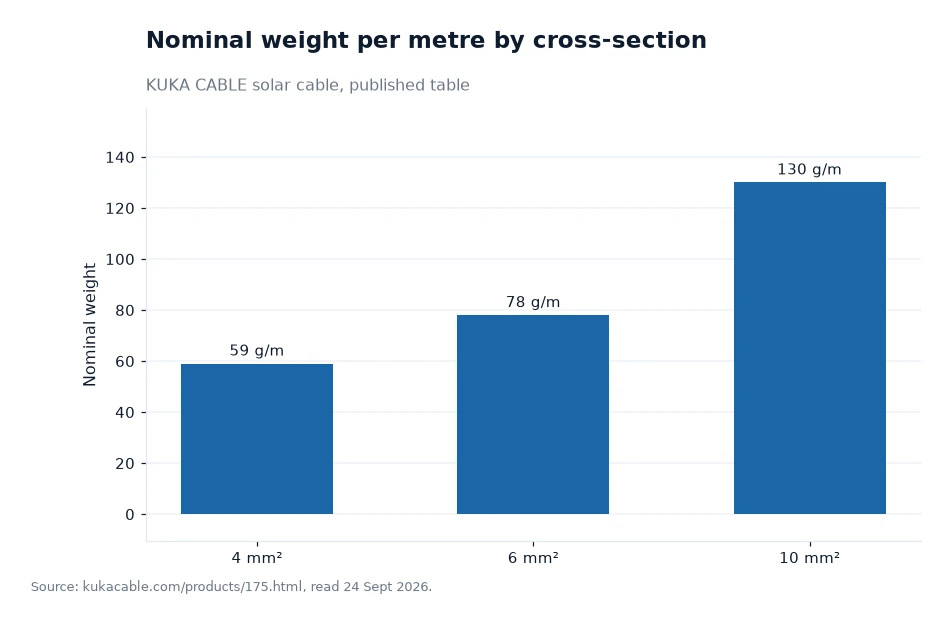
The bars describe mass, not stiffness, and the two are easy to confuse on a cold morning. A 4 mm² cable carries 59 g/m, so a 100 m length weighs 5.9 kg before the drum is added; the same length in 10 mm² carries 130 g/m and weighs 13 kg. Those multiplications are mine, taken from the published nominal weights, and they assume the whole reel is cable.
Mass matters because it is what a fitter feels when pulling a stiff cable into a radius. A heavier cable held at the same tight bend puts more load on the jacket and on the clip holding it, and in cold conditions that load arrives while the material has the least stretch available. Handling weight is one reason a project keeps the cross-section no larger than the electrical design requires.
Where cold-weather bends go wrong
Four places account for most of the problem. The first is the combiner-box entry, where the cable is pushed into a gland and turned immediately. The second is a tray corner where the last clip sits inside the curve, holding the bend at whatever radius the clip imposes. The third is a conduit run with a factory elbow tighter than the cable allows. The fourth is the strain relief, where a tie pulls the cable hard against a bracket and removes the slack that would otherwise spread the bend.
The published data gives a way to check all four without instruments. Measure the outside diameter of the cable on site — nominally 5.5 mm at 4 mm² — then multiply by four and compare the result with the radius the fitting forces. Where a fitting cannot be changed, the bend has to be moved away from it. Where the cable must turn inside the limit, the alternative is a larger cross-section with a larger published radius rather than a tighter pull on a smaller one.
Cold, wet and loaded at the same time
Cold rarely arrives alone. The published test list places water resistance, UV accelerated weathering and abrasion testing beside the two cold tests, which is a fair description of winter service on a rooftop: moisture on the jacket, low sun angle with ultraviolet exposure still present, and ice or grit abrading the sheath where it moves. Tensile strength before ageing is published as at least 8 N/mm², and the long-term service life as 25 years or more, or 30 years on one product page for the model it describes.
The material choice behind those figures is XLPO on both the insulation and the sheath, electron-beam cross-linked and LSHF, over a tinned copper conductor of class 5 flexibility to IEC 60228. Cross-linking is what keeps a jacket from creeping under permanent load; tinning is what keeps a cut end from corroding when it sits wet through a winter. The range is described against TUV 2PfG 1169/08.2007, EN 50618:2014 and IEC 62930, so the cold tests sit inside a published standard rather than beside one. Anyone buying a 4mm solar cable for a cold-weather programme should read those two rows before the jacket rows, because they decide how the cable behaves on the day it is installed.
| Cross-section | Overall diameter | Nominal weight | Radius at 4 × diameter (my arithmetic) |
|---|---|---|---|
| 1.5 mm² | 4.6 mm | 34 g/m | 18.4 mm |
| 2.5 mm² | 5.0 mm | 45 g/m | 20.0 mm |
| 4 mm² | 5.5 mm | 59 g/m | 22.0 mm |
| 6 mm² | 6.0 mm | 78 g/m | 24.0 mm |
| 10 mm² | 7.5 mm | 130 g/m | 30.0 mm |
| 16 mm² | 8.8 mm | 190 g/m | 35.2 mm |
Worked example
Put the elongation figures next to a length of cable. A one-metre sample tested to the published minimum of 125% elongation would stretch to 2.25 m before the insulation tears; the same metre at the stated 185% would reach 2.85 m. Both conversions are mine, from the published percentages, and they assume a uniform stretch along the sample rather than a local tear.
Now apply the same reasoning to a winter bend. The published radius of 22 mm at 4 mm² is not a target; it is the tightest curve the cable is published to accept. A 90-degree turn at exactly that radius has a developed arc length of one quarter of 2 × π × 22 mm, which is 34.6 mm of cable consumed by the bend. That figure is my own calculation, and it assumes a constant radius through the whole turn. Knowing it is useful when cutting cable runs before installation, because a cold-weather layout with several such turns is longer than the straight-line drawing suggests.
Frequently asked questions
What is the minimum bending radius for a 4 mm² solar cable?
The manufacturer publishes a minimum bending radius of 4 × the outer diameter, and the same table gives an overall diameter of 5.5 mm for the 4 mm² size, which makes the limit 22 mm by a calculation of mine from the two published figures.
Does cold weather reduce the bending radius?
The published figures do not change with temperature; the radius stays at 4 × the outer diameter. What changes is the force needed to reach it, which is why the manufacturer publishes a cold bending test and cold elongation testing alongside an ambient range of −40 °C to +90 °C.
What to plan before a winter install
Mark the four risk points on the drawing — box entries, tray corners, conduit elbows and strain reliefs — and write the published radius beside each. At 4 mm² that is 22 mm; at 6 mm² and 10 mm² it is 24 mm and 30 mm. Where a fitting forces a tighter turn, change the fitting or change the cross-section rather than relying on how the cable behaved in a warm warehouse.
Then ask for the paperwork that supports the plan: the datasheet with the measured diameter for the model ordered, the batch test record covering the spark test at 10 kV and the finished-cable test voltage of 6.5 kV AC for five minutes, and the certificate copy naming the standard. The manufacturer publishes its range in the solar cable section, the dimensional table on the cross-section page, the low-temperature work on the test list and the construction detail on the 1500 V product page.
Bending and weight figures used in this piece were read from the manufacturer's own website, kukacable.com, on 24 Sept 2026[1].